
We live in a time when the questions we ask about ourselves are changing. What does it mean to belong? To be governed? To find purpose when old certainties collapse under the weight of technological and societal acceleration?
This post emerges from a deep conversation held on Jon Mallia’s podcast, where Malta was both lens and mirror for exploring global anxieties and ambitions. From AI to ethics, from politics to the meaning of work, we traced a map of our collective unease… and our possibilities.
Digital Identity and the Fragmented Republic
Seventy percent of Maltese say they’re proud to be Maltese. And yet, scratch the surface, and the picture reveals fissures. Young people feel less anchored to the national identity. Many wish they had grown up elsewhere. In a world where one lives increasingly online, what defines a nation?
Language and family still hold firm. The Maltese language remains central, and the family remains the foundation of social value. But religious adherence has shifted: more people trust personal judgment rather than ecclesial authority. Political loyalty is fraying. Forty-two percent of voters are willing to change their vote. Institutional trust has eroded. The new sacred is proximity: people trust themselves, their family, their inner circles. What we’re seeing is not the end of identity: but its digitisation, its pluralisation, its fragmentation into further self-reassured units.
One generation still clings to bread-and-butter issues. Another dreams of wellbeing, sustainability, and a life of meaning. Between them lies a cultural ocean: one of memes, AI agents, digital rituals and a political system that often doesn’t know how to speak their language.
A society without compassion, as the local rise of impersonal gig economies like Bolt and Wolt show, becomes brittle. But a society that centres wellbeing and empathy; that sees connection as infrastructure, not accessory can remake itself.
The Philosophers Who Shaped Malta’s Compass
Peter Serracino Inglott and Eddie Fenech Adami, though different in temperament, shared a profound political and moral seriousness: a commitment to ideas and to people that feels increasingly rare today.
Serracino Inglott was Malta’s quiet revolution: an architect of moral modernity. Steeped in Christian personalism and existentialism, he placed the human person, not the system, at the heart of politics and technology. He believed the digital future must be rooted in human dignity long before AI ethics became fashionable. For him, dialogue between faith and science wasn’t naïve: it was necessary.
Fenech Adami, for his part, was Malta’s builder. A statesman who believed in community over ideology, in subsidiarity over central command. For him, decisions should be made as close as possible to the people they affect. He governed not through rigid processes but through an ethical compass.
Both men rejected the notion that politics could be reduced to mere machinery or mechanistic systems. For them, governance was not the blind application of processes, but a moral endeavour rooted in human dignity, ethical discernment, and the primacy of personal responsibility. They believed governance should serve the soul of a nation not merely its spreadsheets. Their legacy is a reminder that ethical leadership is not nostalgic; it’s urgent.
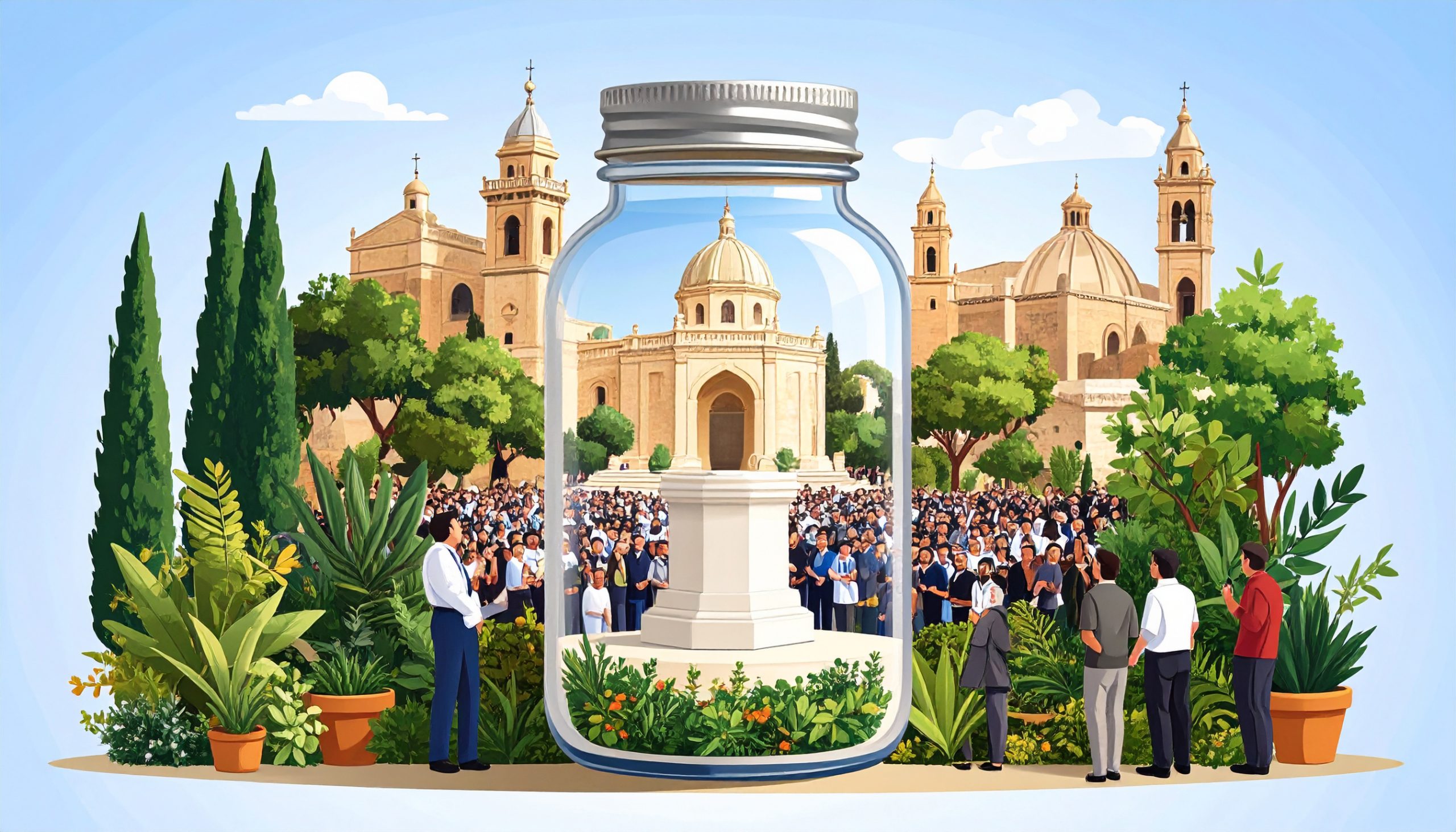
Lessons From The Family Kitchen
I was raised in a home where ideas were cooked and tested like meals in a kitchen: seasoned, challenged, served with warmth but also discipline. That space taught me more about leadership than any textbook ever could.
My brother and I learnt that truth comes before popularity. That real leadership is not about holding office but about enrolment. That the hardest decisions aren’t black or white, but require integrity, information, and process. And perhaps most importantly, that courage is knowing when to ask for help.
Entrepreneurship and Social Benefit
Many believe that business is about profit. That success is measured solely in quarterly growth and margins. But what if we flipped the lens? What if business could be the scaffolding for social renewal?
In Malta, where politics often feels too slow, too tangled in cycles and slogans, the private sector has become – at least for me – a site of experimentation. Nowhere is this clearer than in AI and healthcare. At EBO, we’ve seen how AI can do more than automate: it can amplify the human. We’ve built tools that ease administrative burden in hospitals, allowing clinicians to return to what matters most: care. We’ve deployed conversational agents that help the UK’s NHS engage with patients more meaningfully, while saving money and time.
Innovation becomes powerful when it is ethical. When it democratises access rather than centralises control. When it creates public value, not just private equity. We don’t just believe this: we operationalise it, because a business that strengthens society, in the long run, strengthens itself.
Wellbeing as Strategy
Talk of wellbeing often gets lost in sentimentality. But to see it strategically is to recognise its transformative potential. A healthy society isn’t just less sad. It is more resilient, more innovative, more connected. From the rise of running clubs in Malta to urban planning aimed at social cohesion, we are beginning to realise that wellbeing is not the opposite of productivity, it is its foundation.
Wellbeing means autonomy: freedom to shape one’s life. It means purpose: choosing work and relationships that reflect one’s values. It means connection: mental health, green spaces, trust in institutions. In my view, the wellbeing agenda may be the most underexploited political lever of our generation.
Politics and the Long Shadow of Short-Termism
In many democracies, Malta included, politics is struggling with a chronic condition: short-termism. Headlines dictate policy. Visibility trumps vision. Parties market themselves like brands, sacrificing ideological depth for viral slogans.
This is not a uniquely Maltese crisis. But it is one we feel acutely on an island where community is tight-knit and memory is long. The overemphasis on immediate wins means structural issues; like sustainability, climate, AI governance receive lip service but little strategic attention.
We need institutions that plan beyond electoral cycles. Independent commissions that can steward long-term thinking. And above all, a culture of public discourse that rewards complexity rather than punishes it. Our politics needs fewer performers and more architects.

Why I Didn’t Enter Politics
The question arises often: why not enter politics? After all, the issues I care about (ethical technology, societal wellbeing, public trust) are political at heart.
And yet, I believe impact can be broader outside the chamber. The academy, the private sector, civil society: these are also sites of transformation. They are often faster, more agile, more open to experimentation. My mission remains the same: to contribute to a better society. But I choose to do so through the realms of innovation and reflection, not through electoral campaigns.
Politics matters deeply. But it is not the only route to moral and civic contribution.
The Future We Could Build
I yearn for a diversified economy where success isn’t measured by cranes, but by quality of life. An education system that teaches critical thinking, digital fluency, and lifelong learning. A healthcare system that values prevention, mental wellness, and personalised care. A public sector reimagined through AI not as a bureaucracy, but as a service. We could have all this. But it requires vision. And a rejection of cynicism as default and the short-term cycles of the present political system.
And it requires us to believe something deeply radical: that Malta’s smallness is not a disadvantage. It is a laboratory for bold policy. A testbed for democratic renewal mediated by technology.
Our education systems are under strain; not just from underfunding or outmoded pedagogy, but from a deeper misalignment. We are preparing young people for a world that no longer exists.
We send them into the digital wilderness with no map: unable to parse truth from fiction, influence from manipulation. We teach them to memorise, not to question.
Education must evolve. Tools like Khan Academy and AI-powered tutors allow for personalisation at scale. Teachers can become mentors and guides, not mere transmitters of content. Literacy must mean digital literacy. Understanding algorithms as well as Shakespeare is mandatory. To me, education is no longer just about information. It’s about sense-making in a world bursting with too much information.
What happens when machines can do the tasks we once defined ourselves by? The AI revolution challenges not just jobs, but our concept of work itself. It forces us to ask: What do we value? What do we protect? How do we reward contribution when productivity is no longer the sole metric?
Universal basic income, data dividends… these are no longer fringe ideas. They are structural rethinks of the social contract. At the same time, AI gives us tools to humanise bureaucracy: to allocate resources more efficiently, target welfare more precisely, predict crises before they explode. That’s why this is no longer a debate about tools. It is a debate about values. About how we coordinate society when old assumptions no longer hold.

The Media Mirror
We live in fragmented realities. Traditional outlets no longer dominate; influencers, podcasts, and niche platforms have captured the public ear (and mind). Each stream caters to its own algorithm-fed bubble, and while this creates diversity, it also deepens echo chambers.
AI personalises what we read and watch, but in doing so, it risks shrinking our worldview. Disinformation travels faster than ever before, mimicking truth with uncanny precision. Public trust has eroded: both in institutions and, sadly, in the idea of truth itself.
The media must not only inform; it must educate. It must become a partner in civic literacy. Fact-checking, transparency, and engagement are no longer luxuries: they are prerequisites for democratic survival. But, the real battle is not over facts. It’s over curiosity….
The Moral Case for Curiosity
If there is a single virtue that must be revived, it is curiosity. In times of ideological entrenchment, to remain curious is an act of moral courage.
Curiosity keeps societies open. It guards against manipulation, populism and the complacency of received wisdom. It drives innovation, yes, but also compassion. A curious citizen seeks to understand before condemning, to learn before reacting.
And yet, we do not teach curiosity. We suppress it in education, starve it in our politics, and overwhelm it in our media. We must reverse this. The societies that will flourish are those that cultivate critical dialogue, celebrate intellectual humility, and reward the question—not just the answer.
Forward, Together: Technology and the Human Spirit
In the closing section of the podcast, Jon Mallia and I looked ahead. What might the coming decades bring? Much, if we are bold! AI coupled with the power of quantum computing will likely cure or significantly manage most diseases, extending life, and transforming further how we live, work, and think. We will witness revolutions in education, climate solutions, agriculture, and perhaps even interplanetary habitation.
But none of it is guaranteed. The promise of AI depends on ethical governance, inclusive design, and a commitment to using power wisely. Technology is never neutral: it reflects the values of those who build and deploy it.
We must not be afraid. But neither should we be naive. Let us see technology not as a threat, but as a call to reaffirm the dignity of the human person. Let us build systems that uplift rather than oppress, connect rather than isolate, illuminate rather than obscure.
AI will not save us. But it can help us save each other.
We are a fragmented nation, yes. But we are also a nation in constant formation.
Between the cracks of identity, work, media, and governance, a quiet but profound yearning is taking root: for a future anchored in meaning, purpose, dignity, and human wellbeing. Ours is not a generation that seeks mere nostalgia; it is a generation that, often wordlessly, demands authenticity and fairness. Our task is not to return to some golden age. It is to forge, with courage and clarity, a future that is more intelligent, more just, and more human.
Malta is small. But as history shows, small places can carry big truths.
We can begin again; not with conceited certainty, but with questions. Always with questions.


No Comments